
I’m so happy to announce that Spirals of Treason—a book ten years in the making—is now available at your favorite retailer. For more info and buy links, click here.
Book launch details:
May 9, 2026 (this Saturday!)
11am-1pm
Cecil’s Country Store
20853 Indian Bridge Road
Callaway, Maryland
The event is the day before Mother’s Day, for those looking for a great gift for mom! Books have already been delivered to this shop if you live locally and want to grab a print copy right away.
This month I’d like to share a special snippet that you won’t find anywhere outside of this newsletter. You won’t find it because it’s a deleted scene. I loved writing it, but my editor thought it was out of place in Mercy Allen’s story.
Enjoy!
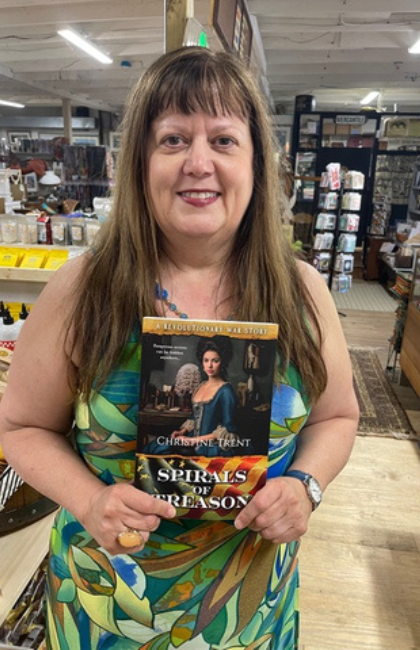
PHOTO CAPTION: At Cecil’s Country Store with a copy of Spirals of Treason, available here in both regular and large print.
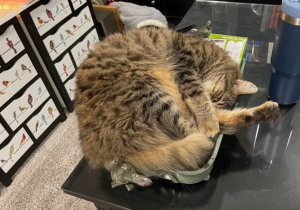
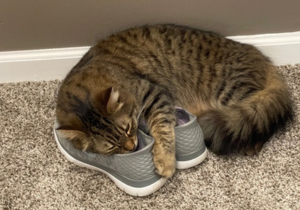
Here’s a dose of fluffy cuteness. Meet Cicero, who always finds the most uncomfortable places to nap.
In other project news, I’ll be starting Breton Bay Booze, a novel about moonshine running during Prohibition, in the next couple of weeks. It is book 5 of my Heart of St. Mary’s County series and will release in July 2027.

 Spirals of Treason, unedited, deleted scene.
Copyright 2026, Christine Trent
June 1768
Boston, Massachusetts
The messenger was red-faced and breathless with his news. “Mr. Hancock, sir, please hurry. Two tidesmen have boarded Liberty and seized it.”
John Hancock carefully put down his silver fork laden with speared asparagus and straightened his lace cuffs. “Is that so? And why, pray tell, was my ship taken?”
“Proper duties weren’t paid.”
“How can that be so? Liberty should contain twenty-five butts of Madeira, for which I’ve already arranged payment.”
“Yes, sir. The captain said to tell you the tidesmen claim that because the ship was only a quarter full that you must have had the rest of the ship secretly unloaded overnight.”
Hancock slowly rose, putting aside his linen napkin and brushing toast crumbs from his ivory-buttoned, floral embroidered waistcoat. “So I am once again accused of smuggling. It would seem that my integrity as one of the king’s subjects is being assailed, would it not?”
“Sir?”
“Tell Captain Scott I’ll be along momentarily to resolve what I’m sure is a misunderstanding on our customs officials’ part.”
Hancock proceeded leisurely after sending the messenger back, determined not to rush to Boston Harbor and appear disconcerted…and therefore guilty. This further accusation against the man whose family’s House of Hancock had been in honest operation for generations would not go ignored.
He wrote a letter to his agent in London, letting him know that the wine butts had arrived and that a shipment of rum, whale oil, and fish would soon make their way back to England. He also dashed out another, more private note.
S—,
You will find it of interest to know that I am once again under consideration by those of whom we spoke at our last meeting. It would be of great value to me if you could secure the necessary means to ensure my ongoing good fortune. I shall be at the same location as before by half past two.
Satisfied that this letter said nothing—but everything—he sealed it and handed both missives off to Nickens, his trusted valet, for delivery.
That done, he asked another servant to bring round a driver and carriage from the stable, giving instructions that they were to travel at a dawdling speed uncharacteristic of Hancock’s typically forceful nature. The servant looked at his master curiously, but went to do his bidding.
Hancock walked unhurriedly down the broad staircase with its carved and twisted balusters into the paneled front hall, so that any gossiping servant would be able to report that the master seemed to not care a whit about his detained ship.
Outside Hancock Manor, originally built by his uncle Thomas, the line of sugar maples that divided his property from the pastureland of Boston Common stood at perfect attention in the stillness of the day’s heat. Hancock had had this perimeter of foliage planted to emphasize the size of his Boston property, and he was well pleased with it. Each passing year’s growth emphasized his stature just a little bit more.
He smiled as he entered the carriage. Today’s events should prove interesting.
At Long Wharf, all was chaos. Hancock’s driver maneuvered the carriage through the sweating, grim-faced crowd that had gathered to witness what the tidesmen were doing. As his carriage traveled down the warehouse-line pier to the end where his ship was docked, Hancock noted that several of the watchers, some of whom he recognized, carried clubs. Rocking menacingly in the water behind Liberty sat a warship, HMS Romney.
Aboard Liberty were several customs officials milling around. Captain Scott stood on deck, silently nodding to his patron as Hancock’s carriage pulled to a complete stop in front of two uniformed officers who stood on the pier in front of his ship. Hancock recognized one of the men as Thomas Kirk, a tidesman who had made trouble for him in the last two incidents involving one of his ships.
He casually stepped out of his carriage, indicating to the driver that he should wait. The breeze blowing in from the Charles River did little to compensate for the day’s warmth.
“Ah, Mr. Kirk,” he said genially, raising his voice so that all around might be witness to the transaction. “Have you found yet more fault with my insignificant shipping concern? Just last month you illegally boarded Lydia, now your sights are on Liberty. If I were an insecure man, I’d think you were jealous of my ships.”
Thomas Kirk reminded Hancock of a beaver, rubbing his paws together while his jaws worked furiously, as though all his thoughts were generated somewhere in his teeth.
“Not jealous, no sir. Just the king’s man looking to serve his sovereign well.”
“Does his Majesty require you to harass me on a monthly basis?”
The beaver sputtered. “Harass you? You, sir, are illegally avoiding the payment due on imported goods. I believe that is known as smuggling.”
Hancock stood as erect as possible to ensure his voice could be heard throughout the crowd. “And the king is illegally rounding up Bostonians and forcing them into the Royal Navy. I believe that is known as impressment.”
A cheer of approval went up from the onlookers and they moved in closer to hear more. The other tidesman, a hefty man that Hancock suspected was enjoying cheese and wine cargo samples a little too frequently, spoke up. “Irrelevant and pointless. Mr. Kirk has now revealed that he observed Liberty secretly unloading wine butts offshore—”
“Are we referring to the same Mr. Kirk who last month swore that nothing of the sort had happened when Lydia was boarded?”
“We now know the truth of that. Mr. Kirk was intimidated by your ship’s crew, who held him captive aboard your ship when he made his investigation, and who only released him when he promised to swear that Lydia had done nothing wrong.”
Hancock burst into laughter. What sorts of idiots were the customs people hiring these days?
“So last month Mr. Kirk pronounced my ship clean because of threats from my crew, but this month he unequivocally states that my ship is involved in smuggling despite the threats my crew must have surely made once again.”
His laughter infected the crowd, who snickered and cackled behind him.
Kirk’s jaw worked furiously. He was coiling up something reprehensible to spit out, for certain.
Reprehensible it was. “I hear say that you’re not only a smuggler, but that you water down your spirits before selling the barrels.”
The pudgy tidesman’s laugh—a combination bark and wheeze—was louder than Hancock’s own, but the crowd was not with the man and he halted his amusement abruptly in the face of a growling audience.
Hancock unclipped his pocket watch from his waistcoat and examined it, adjusting it so that the sun’s rays momentarily bounced off the gleaming, filigreed gold and into the eyes of the tidesmen. He smiled inwardly when Kirk winced.
Hancock’s mood was instantly darkened as he realized that Romney was no longer sitting out in the water behind his ship, but had sidled along in front of her. Romney’s crew was lashing ropes out to Liberty. Good God, they meant to take her as a prize.
“What is the meaning of this, sirs? How dare you impound my ship and goods when no wrongdoing has been proven against me?”
“Wrongdoing will eventually be proven against you, and that is enough,” Pudgy said.
“So once again the Crown is abusing one of its citizens by not allowing him a fair and just trial? I’m to be punished without a shred of evidence as to my guilt? Without witnesses? No formal declaration of charges? Only your jealousy-driven accusation?”
“There is evidence aplenty, sirrah.”
“And I tell you, sir, that the only evidence aplenty in existence is that you have an irrational fear of Bostonians, the most stalwart and faithful of the king’s subjects.”
Voices in the crowd piped up. “Well said, Mr. Hancock!”
“Tis true, what he says!”
“One Bostonian’s worth ten of the likes of them, Mr. Hancock.”
“No more impressments!”
The tidesman’s eyes narrowed, to Hancock’s great satisfaction.
It is never good when a throng of perspiring, ax-grinding men are given a culprit to condemn, is it, Pudgy?
“You will release my ship at once,” Hancock said. A crew member on the deck of Romney made an obscene gesture in response to Hancock’s demand. It did not go unnoticed by the crowd who shouted obscenities back at the man.
Kirk had found his voice once again. “We’ll do no such thing. The Crown is taking your ship as payment for evasion of duties.”
“On whose authority? Yours, Mr. Kirk?”
Pudgy stepped forward. “I represent the king. My word is his.”
Hancock knew that this was it, his moment. He turned to face the eager crowds, many of whom were fanning their faces with their hats, exposing the cheap, unpowdered wiglets tied under their own hair as rivulets of sweat ran down their brows and cheeks. “We love our king, but his representatives in our loyal town disparage his good name. They seize our ships, our men, and our honor. Men like Mr. Kirk and Pud—other customs officials—extort money from British citizens, preventing them from doing business with his Majesty, and leaving them in pitiful circumstances. I say to you, my friends, that we will tolerate this no longer.”
He turned back to the tidesmen, raising his voice even higher. “And I say to you, sirs, that this persecution ends today. We demand justice!”
A roar of approval went up from the crowd. Kirk and Pudgy blanched, but Pudgy quickly recovered himself.
“Justice is what you’ll have Mr. Hancock, from inside a prison cell. Now be off with you before I call a sentry and have you arrested.”
“No sir, I’ll not leave. Not without my ship in my possession. You’ll have to take me in chains before that happens.”
“Right you are, Mr. Hancock!” That sounded like Jeb Williams.
“They’ll have to pass through us to cart you off, and we’ll be ready for ’em.” That was definitely Mister Scott. Sam had done well in selecting this cohort.
An early June tomato, green and hard, came hurtling from somewhere in the crowd, striking Kirk squarely between the eyes. The man shrieked in outrage and rubbed his forehead with a hand that extended into long, yellowed fingernails.
Hancock could barely control his distaste. Truly, where did these undesirable specimens come from?
Meaningful looks passed between the two tidesmen, and Pudgy nodded towards Romney.
A few cannons lethargically made an appearance through their gunports, and marines on the quarterdeck brandished weapons. When another piece of unidentifiable fruit, this one pink and ripe, splattered across Pudgy’s ample torso, the crowd reacted with more cheers.
The tidesmen reacted with their feet.
Kirk scurried, while Pudgy waddled, to Romney. Members of the crowd moved as if to prevent the men from boarding the ship, inciting the marines to raise their weapons, but Hancock held up a hand to stay the town’s residents.
Let the tidesmen flee in the face of determined Bostonians. The presses would be stamping out this information furiously overnight for consumption tomorrow morning. In a couple of weeks, the news would have spread across the Atlantic seaboard.
The two men scrambled aboard the warship, which started back out to sea accompanied by belligerent shouts from the dock. Liberty was still lashed to Romney, but Hancock knew that was only temporary. As they all watched, Romney made a turn towards Castle William, the small island fort that loomed up in the south end of the harbor. Pudgy and Kirk appeared on the quarterdeck, shouting back to Hancock that his fate was sealed.
Hancock was well aware what was likely to happen next. He would be arrested at home and thrown into jail to await some frippery of a trial. Bostonians would be incensed and begin rioting. Perhaps the outrage would spread to other colonies.
If so, the potential loss of Liberty would be worth it. He chuckled inwardly at the irony of that statement.
As he climbed back into his carriage, well pleased with events as he accepted the well wishes of the crowd, Hancock made a mental note to pay a call on his good friend, John Adams, as soon as possible. He would need a good lawyer for his defense, not that it mattered. He had already won in the court of public opinion.
In fact, the public was now stampeding en masse towards the custom house offices, where no doubt they would shortly be destroyed.
Hancock’s cheery mood returned.