
Happy Labor Day! We associate the day with the end of summer, the start of school, great sales and food-filled picnics, but did you know:
- It occurs on the first Monday of September as an ideal date for a public celebration, owing to generally good weather and because it sits midway between the Fourth of July and Thanksgiving holidays.
- Matthew Maguire, Secretary of the Central Labor Union of New York, is often credited for proposing National Labor Day holiday inn 1822.
- Ironically, Peter J. McGuire (no relation), a vice president of the Federation of Organized Trades and Labor Unions, has also been deemed the individual making the proposition for a “general holiday for the laboring classes.”
- Regardless of who the rightful originator of the idea is, Oregon became the first state to make it an official public holiday in 1887.
- By 1894, 30 U.S. states celebrated Labor Day.
- On June 28, 1894, President Grover Cleveland signed a bill into law making Labor Day an official federal holiday.
Enjoy those hot dogs, hamburgers, potato salad! And if you’re looking for something to do over the holiday weekend, curling up with a good book is a great idea!
By the way, my thanks to everyone who attended my signing at Cecil’s Country Store on August 10th. I was especially warmed by those of you have attended more than one of my signings. You are becoming such beloved faces!
I’m also appreciative of Jack and Swannee Tippett’s hospitality in hosting me and being such enthusiastic supporters of my books.
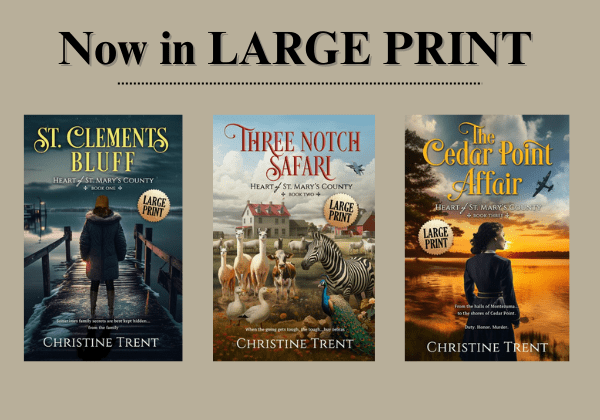
Did you know that Cecil’s Country Store is the only local retailer carrying large print version of my books? To see a full list of Local Shops carrying my books, click here.
Sneak Preview of The Madness of Moll Dyer!
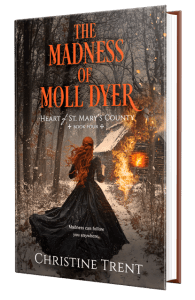
Are you familiar with Moll Dyer, St. Mary’s County’s famous 17th century witch? I’m blending what little is known of her with my imagination (always grounded in research, of course!) to write a novelization of her infamous life. Here’s a tidbit from the draft manuscript, taken from the early part of her life when she still lived in England:
Once in Clapham, Moll was agape at the number of men walking along the cobblestone paths in black hats so tall they looked like sooty chimneys on their heads. The men all had the strange hair style of that Parliamentary man that had burst into the inn she and Dada had been at months ago.
But these men were not dressed quite as fine as the inn brute had been. Their clothes were much simpler and more somber, which seemed to affect their ability to smile.
“We’ve run into a nest of Puritans,” Dada said softly. “Best to conduct our business and be gone. Keep that red hair of yours out of sight.”
Moll patted around her coif to ensure no strands were falling out. They were safe, as long as green eyes, a too-long nose, and a coltish gait, didn’t suggest anything bad to others around her.
Puritan women, who wore variations of the same funny hats as the men, also wore somber clothing with little decoration.
Moll would have thought they looked sad, except they moved with such…determination.
That determination gave them a confidence Moll had never seen before. It also made them unmovable when it came to Dada’s potions. He quickly realized that none of them were interested in a beauty elixir, so he switched to pain remedies and disease cures, but they weren’t very responsive to those, either.
“The Lord only gives us what we can bear.”
“Pain is a reminder of our own wickedness.”
Her father was able to sell a few pots of creams, but it was clear that this town would not be profitable.
“I think we are done in Clapham,” he said.
They walked over a bridge toward the river’s path back to Kenn. At the base of the bridge was a pie seller. Moll’s stomach grumbled so loudly that Dada stopped to look at her. “Child, have I neglected to feed you at all today?”
Moll didn’t want to accuse her father of anything. “I’m a little hungry.”
Dada stopped at the pie seller’s booth, which was filled with every manner of sweets and savories wrapped up in fresh doughs.
As they looked at the seller’s wares, Moll noticed that the seller, a burly man who looked to be frequently sampling his own foodstuffs, crowned at them.
“Are you a non-conformist?” the pie seller asked. It sounded like an accusation to Moll.
“Naturally, we worship in the only true way,” Dada replied, not looking up from where he was examining an unbaked fish pie.
Moll marveled at her father for his ability to tell the truth yet make the questioner believe it was what he wanted to hear.
Placing Moll—who was much maligned by her neighbors—inside the historical context of her times has been very rewarding for me. I like to think Moll will be pleased with the final result—and that you will be, too. Coming February 2026!
Come Say Hello
I’ve added some more book signings to my list. Don’t forget to visit the Appearances page for a complete listing of my upcoming book-signings and events. It would be a treat to meet you and say “hello.”